
Non-fiction
Accountability as a Control System
Redesigning Who Sees, Who Stops, and Who Owns Outcomes
Abdul Jaleel Kavungal
About this book
About this book
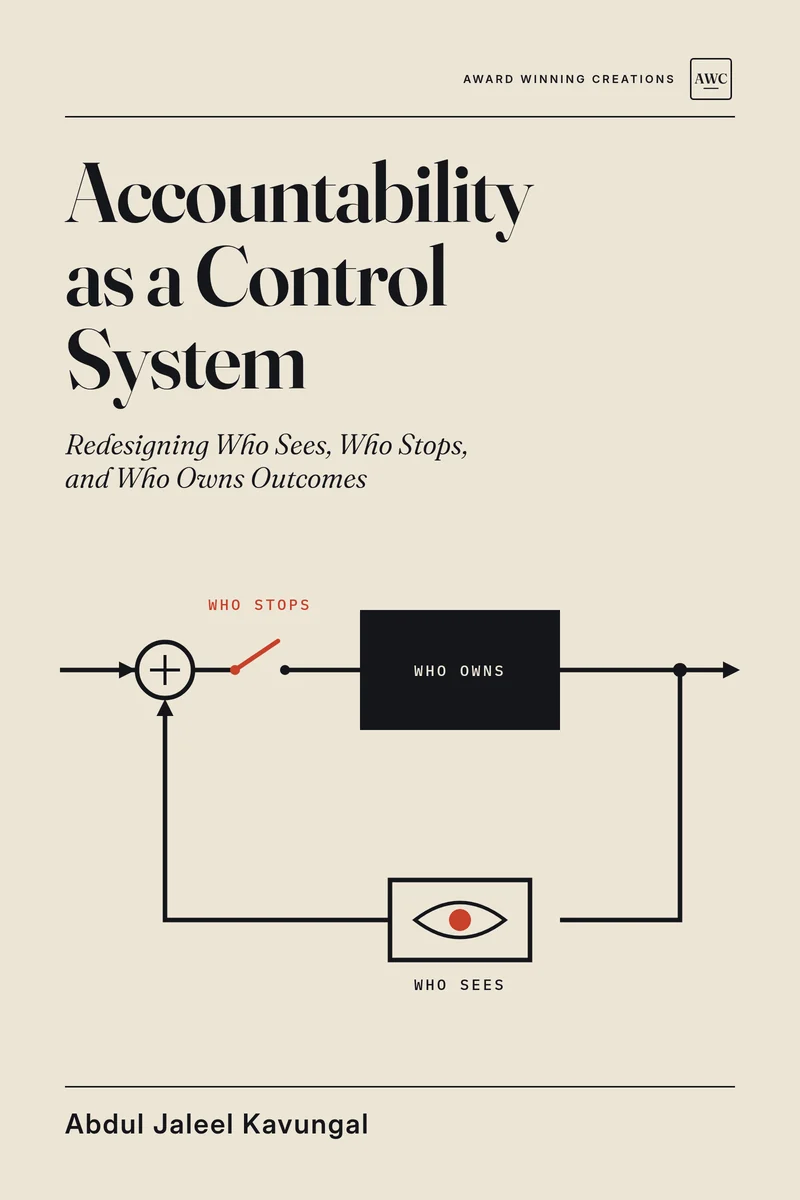
When institutions produce outcomes nobody intended, this book treats the failure as a control problem that can be redesigned. Working from public inquiries into the 737 MAX, the Post Office Horizon scandal, Robodebt, Wells Fargo, Dieselgate, Grenfell and the 2008 financial crisis, it asks three questions of any critical process: who sees, who stops, and who owns.
Accountability as a Control System starts from a familiar scene: the review meeting where a harm is acknowledged, a committee is formed, and the loop that produced the harm stays open. The book reads that pattern through the working vocabulary of control systems: sensors that go quiet, delays that turn near misses into disasters, playbooks smaller than the world, overrides that work only on paper, and ownership that runs in one direction. Part I sets out the diagnosis, including accountability sinks and false overrides. Part II tests it against checkable public cases in aviation, postal accounting, welfare automation, retail banking, emissions testing, building safety and financial supervision, in the language of inquiries, regulators and courts. Parts III to V move from autopsy to architecture, with chapters on the sensing fabric, pushing authority to where variety lives, what the system owes the frontline, and governance that can still feel pain. The appendices include an instrumentation checklist, a failure mode catalog and case source notes.
The letter arrives on a Tuesday. Or the call.
Contents
Chapters
- PrefaceThe Promise
- Chapter 1Outcomes Nobody Intended
- Chapter 2The Sink: How Responsibility Disappears on Purpose
- Chapter 3When the Playbook Is Smaller Than the World
- Chapter 4The Stop Button That Only Works on Paper
- Chapter 5Single Sensor, Hard Authority: The MAX
- Chapter 6The Computer Said Guilty: Horizon
- Chapter 7Robodebt and the Efficiency Sink
- Chapter 8What You Measure Is What You Train: Wells Fargo
- Chapter 9Dieselgate: When Attenuation Is the Strategy
- Chapter 10Grenfell: Decades of Signal, No Stop
- Chapter 112008: When the Sentries Left Their Posts
- Chapter 12Shared Consciousness Is Not a Vibe
- Chapter 13Push Authority to Where Variety Lives
- Chapter 14Both/And or the Sink Wins
- Chapter 15Draw the Loop
- Chapter 16Sensors and Stop-Rights
- Chapter 17What the System Owes the Frontline
- Chapter 18Governance That Can Still Feel Pain
- Chapter 19Who Sees, Who Stops, Who Owns
- Appendices
- Appendix AInstrumentation Checklist
- Appendix BFailure Mode Catalog
- Appendix CCase Source Notes
- Appendix DReading Notes / Source Braid
Details
The edition
- Author
- Abdul Jaleel Kavungal
- Publisher
- AWC · Award Winning Creations
- Category
- Non-fiction
- Year
- 2026
- Pages
- 391
- Language
- English
- Status
- Published
103,036 words.
Read an excerpt
Chapter 1: Outcomes Nobody Intended
The letter arrives on a Tuesday. Or the call. Or the internal memo that begins with a phrase designed to sound calm: We have become aware of an issue. Somewhere downstream of a process that looked, on paper, like a triumph of modern administration, a person has been harmed in a way no slide anticipated. A customer discovers accounts they did not open. A claimant is told they owe money the law did not authorize. A subpostmaster is treated as a thief because a screen said so. A building burns. An airplane does not climb. A balance sheet that was supposed to be resilient turns out to have been a story the institution told itself.
In the rooms where institutions respond, the first explanations arrive fast. Someone failed to follow the process. Someone had the wrong values. The culture was broken. A few bad apples. A tragic combination of circumstances. A black swan. The language varies by sector and by decade; the structure does not. Harm without a clean owner is narrated as a failure of character, then as a failure of culture, then—if the pressure is high enough—as a failure of “systems” in the vague sense that means everything and therefore nothing.
Meanwhile the people closest to the damage experience something more precise and more insulting: there is no one who can change what just happened to them. The call center reads a script. The caseworker is bound by the model. The branch manager is bound by the terminal. The pilot is fighting a system whose logic was not fully disclosed. The board receives a pack that shows green until the day it cannot. The outcome has traveled. The ownership has not.
This chapter’s claim is simple. When outcomes have no owners, do not begin with morals. Begin with loops. Look for broken sensors, delayed feedback, a response repertoire too small for the world, stop-power that exists only on paper, and ownership that runs one way. Character still matters. Culture still matters. They operate through instrumentation. Redesign the instrumentation and you change what culture is even allowed to mean.
Start with four vantage points. They are not anonymous composites presented as secret casework; they are recognizable roles you have inhabited or sat across from. The particulars change. The bind does not.